


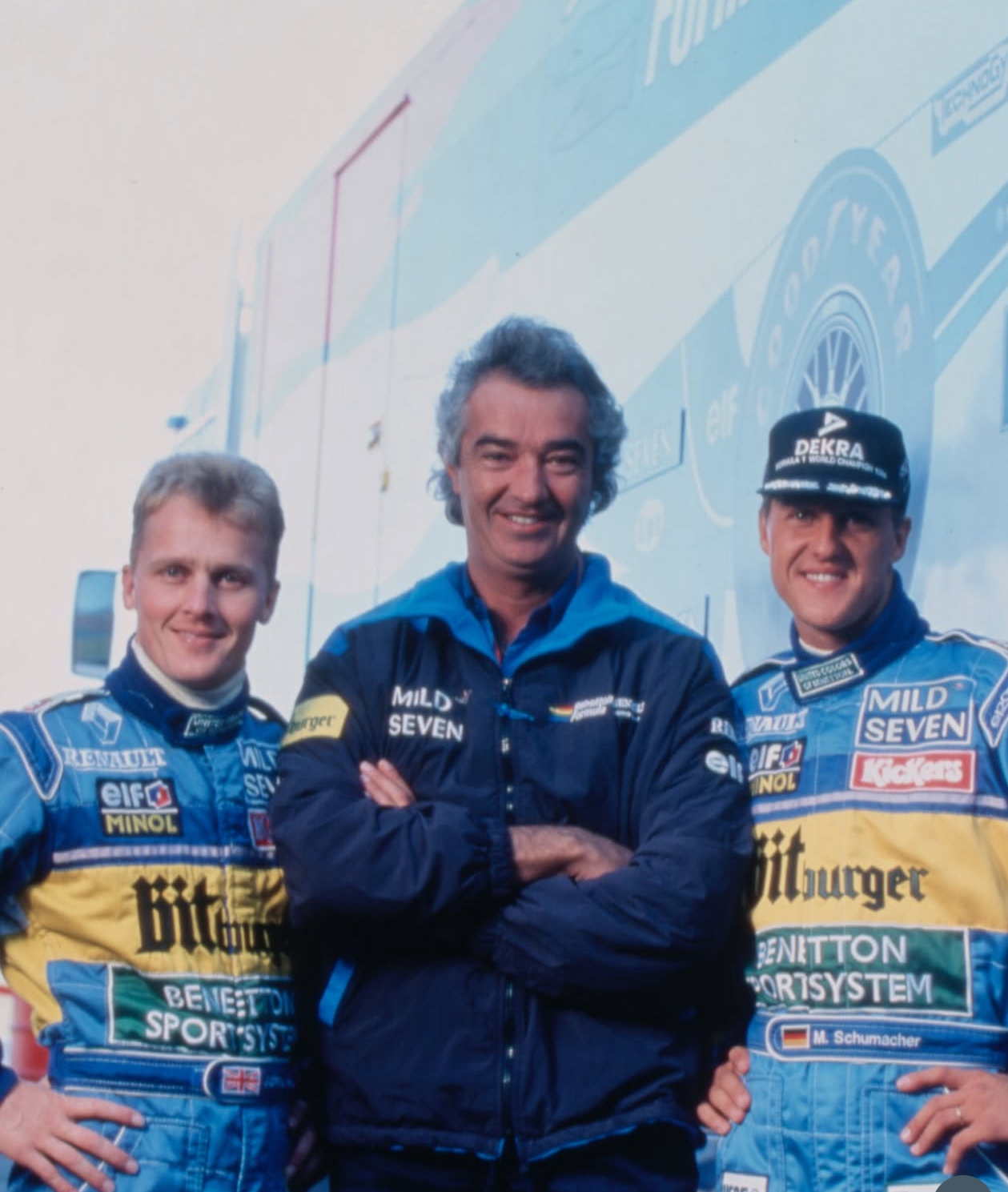
The documentary that reveals how a fashion brand rewrote F1 history
A bold idea, a handful of outsiders, and a vision determined to break the mold. That is the spirit powering Benetton Formula, the new documentary produced by Slim Dogs in collaboration with Sky. After its premiere in Rome and Treviso last week, it is set to air on Sky from November 28, 2025 — ready to pull fans inside one of the most unconventional success stories Formula 1 has ever seen.
The film reconstructs — year after year — the rise of a team no one would ever have bet on: it examines the mindset that allowed a knitwear company with no motorsport pedigree to rise to the very top of global racing. It tells a story of instinct, risk, Italian genius, and a refusal to accept the boundaries of tradition.
Alessandro Benetton: “The value of discontinuity”
During the documentary’s presentation, Alessandro Benetton captured the essence of the team’s entire journey. “To emerge we took many risks. The memories, the emotions, are so many… We had to choose, structure, remove. What emerges is the vision: our desire to do things differently, the value of discontinuity, which I find still extremely relevant today.”
That concept — discontinuity — sits at the heart of the “Benetton Formula” project. It explains their decisions, their boldness, and the unconventional paths they were willing to explore. It also places in context one of the most surprising and impactful choices in the team’s history: bringing in Flavio Briatore.
A vision that started with a simple question
When Benetton entered Formula 1, it was not simply to add a racing program to the company’s portfolio. The intention was deeper: if F1 was the world’s most international sporting stage, then Benetton wanted to reimagine how a team could exist within it. The first spark appeared when the Benetton colors were painted on a Tyrrell, a marketing experiment that stood out on the grid. Soon, Davide Paolini, Benetton’s head of communication and marketing, recognized the potential in a small British team eager to grow. What followed was a blend of Italian creativity, British engineering discipline and a global narrative approach that made the team impossible to ignore.
When Benetton acquired the struggling Toleman at the end of 1985, the move did more than save a failing team — it created a new identity capable of reshaping the sport’s culture from the inside.
Flavio Briatore: From outsider to architect
Flavio Briatore’s arrival in the paddock was nothing short of disruptive. Instead of admiration, he was met with confusion. He was not an engineer, not a mechanic, and not a figure molded by racing tradition. Before entering F1, Flavio worked as a Benetton commercial representative in the Virgin Islands, a world that seemed galaxies away from carbon fiber and data telemetry.
Luciano Benetton brought him into the team as Commercial Director to support Alessandro, with no expectation that he would influence the sporting operation. Yet his outsider perspective soon became his competitive edge. Briatore saw structural weaknesses where others saw routine, and commercial opportunities where others saw obstacles. As organizational shifts moved him into the role of Executive Director in the early 1990s, he transformed the team with fresh vision and uncompromising instinct. The man once dismissed with a skeptical “Who is this guy?” became one of the most influential leaders Formula 1 has known.
1991: the day everything changed
The turning point arrived at Spa-Francorchamps in August 1991. Jordan driver Bertrand Gachot was unexpectedly sent to prison after an incident in London, leaving the team without a driver days before the Belgian Grand Prix. A suggestion reached them from the Benetton side: consider a young German talent named Michael Schumacher.
Almost no one in the paddock knew him. At just 22 years old, Schumacher was quiet, focused and untested at this level. Eddie Jordan hesitated, asking whether Schumacher had ever raced at Spa. His manager, Willi Weber, answered confidently that the young driver knew the circuit perfectly — a complete fabrication. Schumacher had never driven it. He learned it by pedaling around the track on a folding bicycle.
The next day he qualified seventh, astonishing everyone and placing himself between the two Benettons. Suddenly the entire paddock wanted him. But Benetton wanted him more. What unfolded next felt like a motorsport thriller. Both teams attempted to enter Schumacher for the race. Garages were sealed. Lawyers arrived. Meetings stretched deep into the night, and Flavio Briatore, relentless and uncompromising, fought for the deal he believed in. Around three in the morning, the verdict arrived: Michael Schumacher would join Benetton.For Benetton it was a triumph; for Jordan, a bitter defeat. For Formula 1, it was a moment that changed the trajectory of the sport.
Thank You, Michael
In the ruthless world of f1, No one expected that a team born from a knitwear company that had entered the circus only nine years earlier, could reach the very top of the world.
“That day, we became World Champions”, Benetton recalls, “We remember this moment with gratitude. That title remains a reminder of what determination, sacrifice, unity and a winning mindset can build.It reminds us that dreams are reachable when you refuse to let them go. On that day, a dream came true. And it changed us forever”.
A story that still resonates
What makes Benetton Formula particularly compelling is its relevance today. Beyond nostalgia, the documentary serves as a reminder that progress rarely comes from following the expected path. It emerges from risk, vision, courage and the willingness to embrace discontinuity rather than fear it.
In an era when Formula 1 thrives on global storytelling, bold leadership and innovative thinking, the Benetton adventure feels more modern than ever. The documentary shows that sometimes the people who redefine the sport are not the ones who fit in — but the ones who dare to stand out.
To understand how game-changing Benetton Formula was, it’s enough to quote Bernie Ecclestone, the then–Formula 1 boss. “When Benetton entered Formula 1, I told myself something was changing. Suddenly colors appeared everywhere—so many colors. And a glamorous, festive atmosphere emerged, one that did everyone good and forced the others to change as well. That was the great revolution Benetton brought to the sport. But it would never have been credible without the victories and world titles that followed, sealing a commitment that was also technical and industrial. In racing, as in life, you never win by accident.”
Benetton was the first brand not connected to the automotive world to lend its name to a Grand Prix single-seater. Despite having no prior experience or motor racing tradition, it managed to establish itself among the top teams of the period—achieving at least one podium finish in every championship it entered—and experienced its best seasons in the first half of the 1990s thanks to key figures such as driver Michael Schumacher, manager Flavio Briatore, and engineers Rory Byrne and Ross Brawn. During its fifteen years of activity, Benetton won 27 Grand Prix races with Schumacher, Nelson Piquet, Gerhard Berger, Johnny Herbert, and Alessandro Nannini, two Drivers’ World Championships with Schumacher (1994 and 1995), and one Constructors’ World Championship (1995).
Photo Credit: Benetton Formula

Leave A Comment