


The Dakar 2027 was presented this morning in Paris, at the Arab World Institute, the same venue that hosted the presentation of the very first 2020 edition—the one that marked the debut of the great motorsport marathon in the Middle East after ten years of rallies in South America.
Seven editions later, the rally returns to where it began, strengthened by values that time has not eroded: adventure, discovery, adrenaline—a concentration of life packed into two weeks of racing.
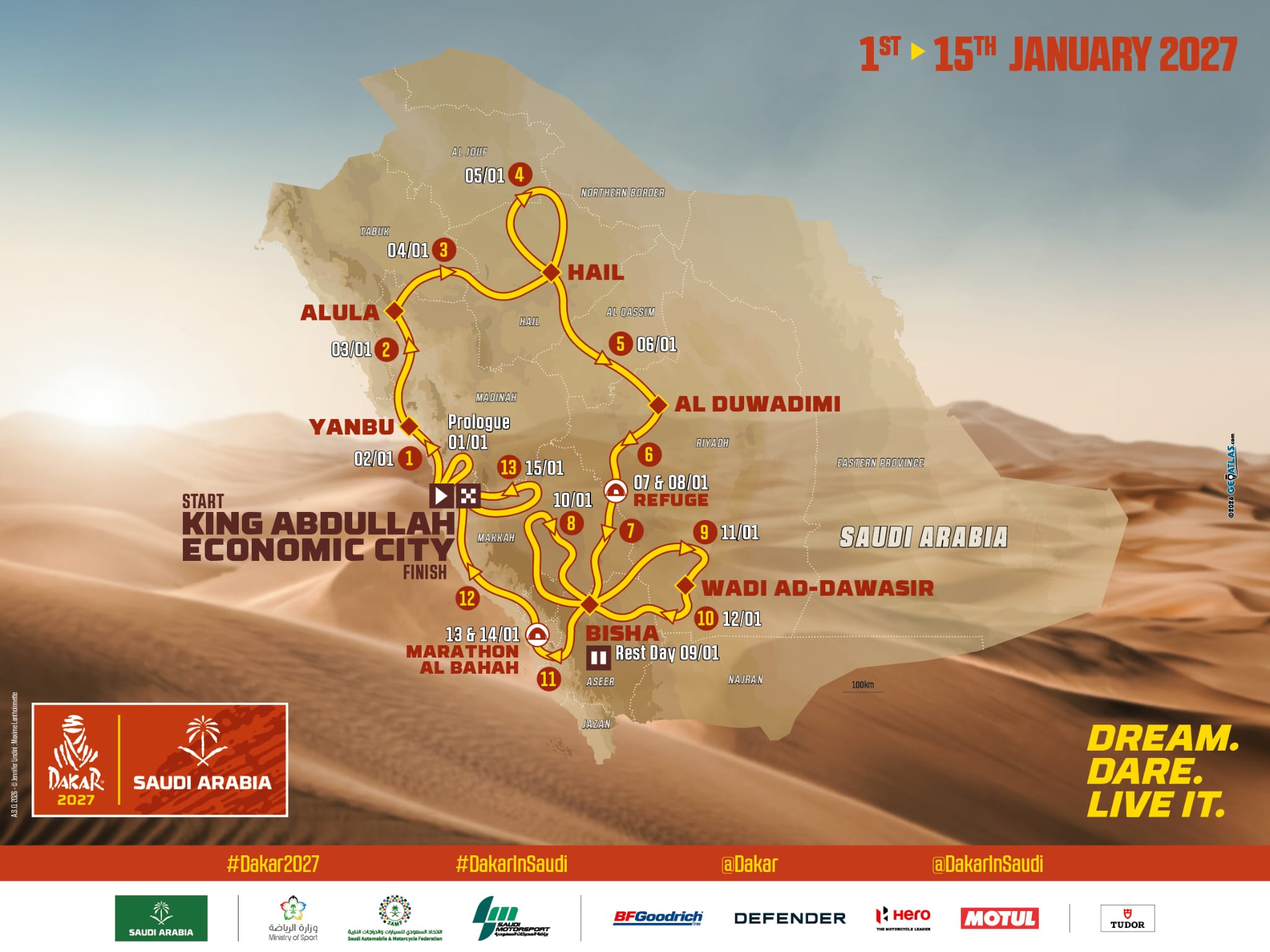
The announcement of the route for the edition that will start on January 1, 2027, from King Abdullah Economic City, on the Red Sea about 100 km north of Jeddah, comes at a time of great geopolitical instability. This issue was also addressed by Prince Khalid bin Sultan Al-Abdullah Al-Faisal, President of the Saudi Automobile and Motorcycle Federation: “We are monitoring the situation, but we would like to emphasize that the Kingdom has the capacity to guarantee the security of its borders and stability. We are ready.”
The Dakar has already faced difficult moments. “It was the only motorsport event held during the pandemic, thanks to the extraordinary cooperation and support of Saudi Arabia,” recalled Yann Le Moenner, CEO of Amaury Sport Organisation, highlighting the organizational complexity of the race, which each year fields more than 500 vehicles, over 800 competitors across cars, motorcycles, trucks, and SSVs, and a caravan of more than two thousand people including teams, organization, TV, and media.
During the presentation, reconnaissance continues in the vast Saudi desert for the preparation of the roadbook. “The work goes on,” explains Dakar director David Castera, who personally oversees every stage of defining the route. “The 2026 edition gave us a memorable race: in the motorcycle category, two seconds made the difference between victory and defeat; in the cars, the gap was 10 minutes. How can we make the race even more unpredictable and intense? That is our challenge. Suspense has been our guiding principle: we wanted to maintain uncertainty until the very end. Staying true to the DNA of the race—endurance, navigation, and speed—the 2027 edition will feature very long, demanding, and varied stages.”
Route
The 49th edition of the Dakar Rally will start on January 1, 2027, from King Abdullah Economic City and will end on January 15, after 13 stages totaling 8,390 km, of which 5,320 are special stages. The traditional rest day is scheduled in Bisha on January 9. Difficulties will not be lacking: very long stages right up to the end—just consider the 905 km of stage 12, the penultimate one—two marathon stages, and technical specials with separate routes for two- and four-wheel vehicles. To make the competition even tougher, motorcycle riders will face sections of pure enduro, while the longest stages will be interspersed with a Formula 1–style pit stop, with teams required to perform assistance as quickly and precisely as possible.
Motorcycles and Cars Race
“Preparation for the new Dakar starts the very day you return home,” admits Fabien Lurquin, navigator for Nasser Al-Attiyah, winner of the 2026 Dakar with Dacia. “The goal is to win the World Rally-Raid Championship and then repeat in January,” the Qatari driver announced in a video message. Dacia had already announced the end of its program at the end of 2026, so it will be interesting to see how the top drivers—Al-Attiyah, Sébastien Loeb, and Lucas Moraes—will be distributed between the two manufacturers competing for victory: Ford and Toyota. In motorcycles, Honda and Ricky Brabec will be at the start with a desire for redemption and the determination to reclaim the longed-for victory that slipped away last January in favor of KTM’s Luciano Benavides by just 2 seconds.

Leave A Comment