


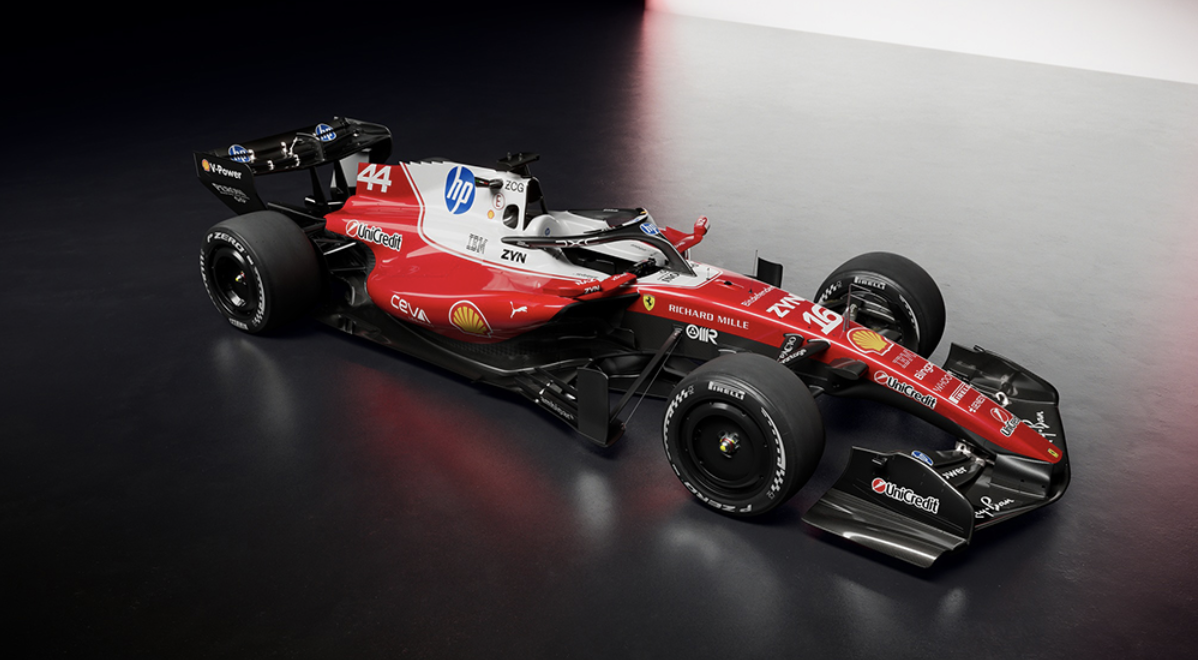
Scuderia Ferrari HP has officially presented the SF-26, the car with which the team will contest the 2026 Formula 1 World Championship, set to begin on 8 March in Australia. Unveiled today at Ferrari’s Fiorano circuit, the SF-26 is the 72nd Formula 1 car built by the Maranello marque and, more significantly, the first of an entirely new regulatory cycle that marks a profound turning point for the sport.
The 2026 season introduces a radically revised technical framework for Formula 1. Cars are lighter, aerodynamics have been fundamentally rethought, and a new generation of power units reshapes the balance between combustion and electric power. Within this context, the SF-26 represents Ferrari’s first interpretation of a clean-sheet set of rules—an ambitious project that sets the foundation for the years to come.
A completely new technical cycle
The SF-26 has been conceived under regulations that required a deep re-evaluation of the car’s overall architecture. One of the most notable changes is the abandonment of ground-effect aerodynamics in favor of a different aerodynamic philosophy. The result is a car with cleaner lines and a design focused on efficiency, weight reduction, and adaptability—key objectives of Formula 1’s new technical direction.
Equally transformative is the 2026 power unit regulation. The new hybrid engines eliminate the MGU-H and significantly increase the output of the MGU-K, now delivering up to 350 kW. This shift greatly enhances the role of electric power and demands a much tighter integration between chassis and power unit than ever before. For Ferrari, this meant adopting a completely new design approach from the earliest conceptual stages, with efficiency, energy management, and system integration at the core of the project.
Design, colors, and identity
The new regulations have also influenced the visual identity of the SF-26. The car’s proportions convey a sense of lightness and agility, reflecting the functional simplicity that guided the designers from the outset. The objective was to create a solid yet flexible platform, capable of being developed effectively throughout the season as on-track data becomes available.
The 2026 livery plays a central role in linking Ferrari’s past, present, and future. While it provides visual continuity with the Scuderia’s heritage, it also introduces notable evolutions. Among the most striking elements is the return to a glossy finish, after seven seasons of matte paint. The chosen Rosso Scuderia is brighter and more intense, inspired by the special livery introduced at Monza during the 2025 season and echoing the reds used around the turn of the millennium. It is a color that reaffirms Ferrari’s core values of passion, courage, and identity.
Alongside the red, white takes on a renewed and more prominent role. Positioned around the cockpit area and on the engine cover, it creates a strong yet balanced contrast, enhancing the car’s overall recognizability. Together, red and white form more than a color scheme—they represent a dialogue between tradition and forward-looking vision, as Ferrari evolves to meet new technical and sporting challenges.
Preparing for the season ahead
With the SF-26 now unveiled, Scuderia Ferrari HP turns its attention to on-track running. The first tests begin next week with a collective shakedown in Barcelona, followed by two test sessions in Bahrain. In a technical landscape that is entirely new for all teams, Ferrari’s approach remains consistent with its philosophy: methodical work, attention to detail, and rigorous data analysis, aimed at achieving steady and controlled progress.
Team Principal Fred Vasseur emphasized that the SF-26 marks the beginning of a completely new journey for both Formula 1 and Ferrari. With new rules governing chassis, power units, fuels, and tires, the car is the result of an extensive collective effort and faces inevitable unknowns. The priority in the early stages, he noted, will be to learn as much as possible and to build solid foundations ahead of the season’s opening races.
Loïc Serra, Technical Director Chassis, highlighted the importance of flexibility in the car’s architecture. The team invested heavily in the conceptual phase to fully understand the new regulatory environment, while ensuring that the SF-26 can be developed effectively throughout the year. In this context, efficiency and the integration of solutions such as active aerodynamics are seen as crucial elements.
From the power unit perspective, Enrico Gualtieri, Power Unit Technical Director, described the 2026 regulations as a genuine philosophical shift rather than a simple evolution. The increased importance of the electric component, the introduction of 99% sustainable fuel, and the removal of the MGU-H required Ferrari to rethink the engine’s architecture from the ground up, in close collaboration with the chassis department.
The drivers’ challenge
“The 2026 regulations require an even more thorough level of preparation, especially from us drivers” stated Charles Leclerc (#16). “There are many new systems to understand and exploit to the fullest, which is why we have been working hard since the very early stages of the project’s development. During my years with Scuderia Ferrari HP, we have already experienced major regulatory changes together: we know how complex the challenge is, but we are working with great motivation to arrive on track as well prepared as possible. Energy management and the power unit will be among the most significant aspects—a stimulating challenge that will require a rapid adaptation process from us drivers, initially relying more on instinct and then increasingly on the use of precise data. The support of the fans this season will be especially important: it is what makes Ferrari so special and pushes us to always give our maximum”.
“2026 represents a huge challenge for everyone: it is probably the biggest regulatory change I have experienced in my career” echoed Lewis Hamilton (#44). “When you enter a new era like this, everything revolves around development and the ability to grow as a team, moving in the same direction. From a driver’s perspective, it has been particularly intriguing to be involved from the very beginning in the development process of such a different car, working closely with the engineers to define a shared direction. It will be an extremely important year from a technical standpoint, in which the driver’s role will be central in managing energy, new systems, and contributing to the understanding of the car. It is a challenge we are facing together, as a team, also relying on the extraordinary support of the fans, which means so much to all of us”.




Leave A Comment