


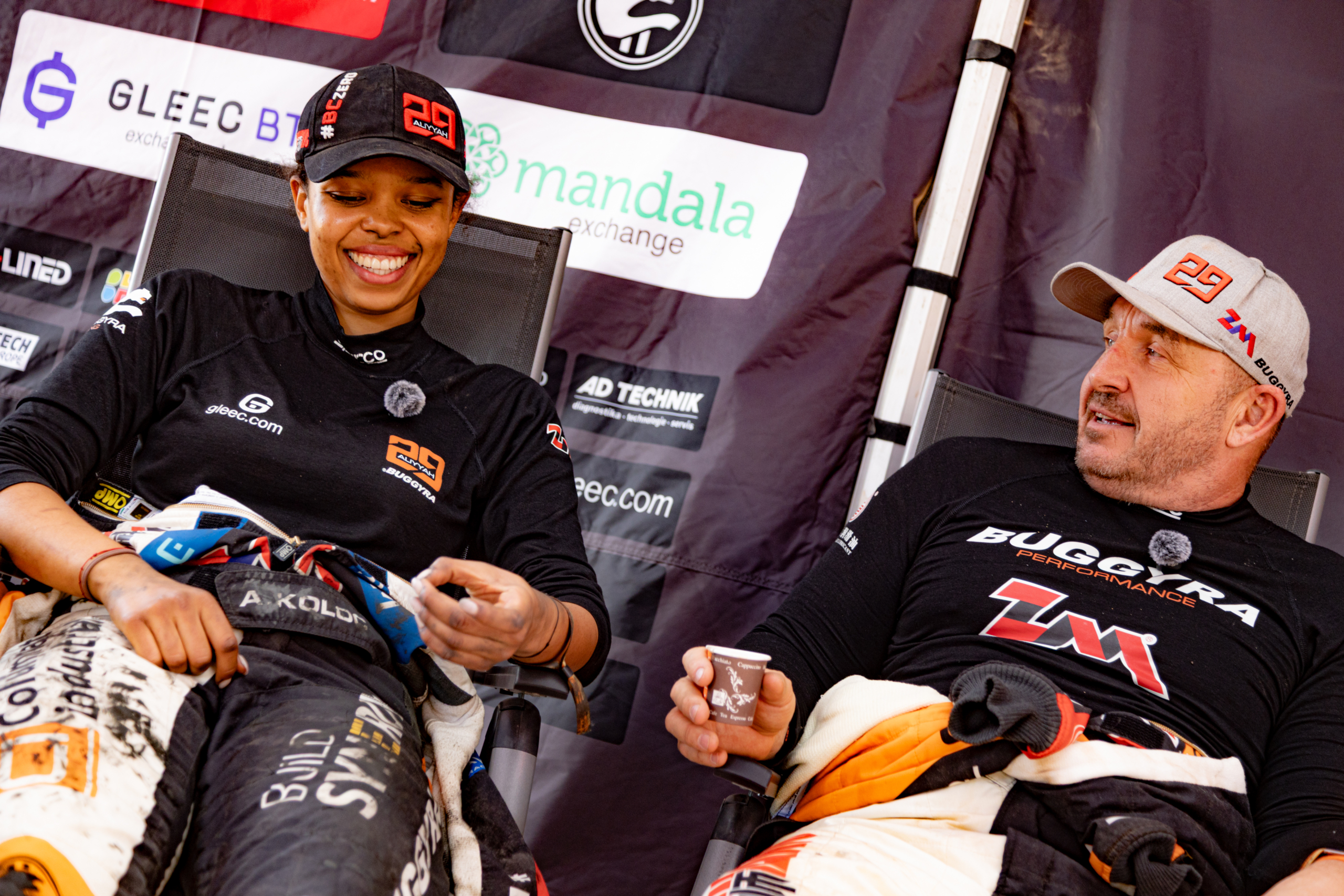
Martin Koloc loves challenges. And it couldn’t be any different considered that at the Dakar Rally, Buggyra Racing takes on the biggest manufacturers in the premier T1+ class with a car developed in-house in collaboration with Redline. With over 50 years of racing heritage, Buggyra Racing is a force on both track and dirt, boasting 6 world speed records, 11 European Truck Racing Championships (both individual and team), 2 French titles, 3 in China, and 1 in India—all in Truck Racing. On the Dakar, Buggyra reached motorsport’s Olympus when Josef Macháček won the T3 Light Prototype category in 2021 with the Can-Am DV21. That victory gave the team an extra boost, leading to their T1+ debut in 2024 with Aliyyah Koloc and co-driver Sébastien Delaunay in the Revo+, following just one year of Aliyyah’s apprenticeship in the T3 category.
This January, Koloc jr #29 will take on her fourth Dakar—joined on the racecourse for the first time by her father, Martin Koloc, two time European Truck Champion, team owner and manager, who usually oversees the rally from the assistance park, managing the overall race.
A Historic First: Father and Daughter in the T1+ In the modern Dakar, it’s the first time a father and daughter will compete side-by-side behind the wheels of two T1+ machines. “We’re both competitive,” confesses Martin Koloc at the Rallye du Maroc, where he’s driving a Revo+ with a V8 engine. “This race is about collecting kilometers in preparation for the Dakar. Only race conditions can truly simulate the grueling challenge of the Dakar. Running two cars helps us gather more data and accelerate development of the vehicle we’re building together with Redline. Our pace is good, but we still need to improve reliability. I’m driving the same car Allyiah used in the 2025 Dakar, while she’s in a new V6 Turbo version—it’s much more powerful and faster.”
As a father, Martin is excited to share the experience with his daughter: “Honestly, it’s much better for me to be in the race with her. If something goes wrong, I can get there quickly, understand the issue, and help find a solution right away. In past Dakars, I was in the bivouac, trying to guess what was happening through a satellite phone.”
We spoke with Aliyyah on the bivouac of the Rally du Maroc
How is it sharing your motorsport passion with your father?
“He’s the team boss and has always supported me. We raced together in Morocco last year and again in this edition to prepare for the Dakar. At first, I was a bit worried not knowing where he was on the stage, but I got used to it quickly. It’s really nice having him on the track—especially during these early stages of the Rallye du Maroc. We’ve had some issues, and he was there to help. It’s a huge support—and also fun.”
You started racing before even having a driver’s license.
“I inherited the passion from my father, who was also a driver. But as a child, I spent more time on tennis courts than in the paddock—I started playing at 4. At 15, I got injured and had to stop playing. That’s when I began following my father’s team, attending briefings, trying to learn everything. It was love at first sight.”
You’ve raced in endurance circuits like GT3 and GT4, as well as in the Dakar. Which do you prefer?
“I prefer off-road. It’s more challenging, and when you succeed, it’s more rewarding than circuit racing. The Dakar is extreme—intense emotions, huge pressure, and much greater risk. So far, I haven’t had the best luck in rallying, but we’re learning a lot. My driving is much cleaner now, and with that comes speed. Rallying is all about stepping out of your comfort zone. I love the desert—it’s unpredictable, and anything can happen. I enjoy the adrenaline, the speed, but also the teamwork and the strategy behind it.”
What impressed you most about the T1+ class?
“The power—and the weight. It really changes how you drive, especially when it comes to braking. We’re talking about a 2-ton car with 350 kg of fuel onboard. Compared to buggies, visibility is much more limited, which took some getting used to. It was a big leap, and you have to learn to do everything faster.”
How are you getting along with the new Revo+ V6 Turbo?
“It’s much more powerful. We are still suffering some reliability issues and we are working on them. The Rallye du Maroc is helping us gather data and make adjustments ahead of the Dakar.”
How do you handle with the mechanics?
“My co-driver Seb (Delaunay) is skilled, but I’ve become pretty good too. This year we’ve had to do a lot of work on the car. For example, here in Morocco, we had a few mechanical problems we had to fix on stage. On SS2, for example, I was going fast, then had brake trouble and hit a rock—it shifted the differential mount and broke the drive shaft. We had to repair it ourselves. I’m proud of how much I’ve improved as a mechanic—though I’d rather not have to prove it so often!”
How does it feel to compete against drivers like Yazeed Al-Rajhi, Sébastien Loeb, or Nasser Al-Attiyah?
“It’s a dream come true—especially at my age. I’d love to be further up in the fight, but I’m still learning.”
Which qualities would you take from the rally legends?
“From Carlos Sainz Sr., his speed and determination. From Loeb, his mindset. From Nasser Al-Attiyah, his speed. From Yazeed, his approach. From Laia Sainz, her determination. She’s shown incredible strength and skill ever since her days on motorcycles. From Lategan? His resilience.”
You started you career as tennis player, do you regret that path?
“It’s different, more luxury and for sure less risky. but with the competition at high level, pressure comes with it and I remember playing tennis with hundreds of eyes on me. I prefer the cockpit of my racing car, where it’s me and my co-driver”.
With 1.7 million followers, do you consider yourself an influencer?
“I feel more comfortable in the desert than on a stage. But social media is an important platform, and I want to use it to share a positive message with people my age: stay focused on your goals and chase them.”
With Foundation 29, you’re also active in sustainability and social projects.
“Yes, the foundation is about making a global impact through two main missions: preserving cultural heritage and supporting autism communities worldwide. We created a botanical garden in Vanuatu, where I have family, to help preserve biodiversity. To support the Foundation, I raced in the Vanuatu International Rally last August. In the near future, I want to dedicate more time to supporting young people with autism.”

Leave A Comment